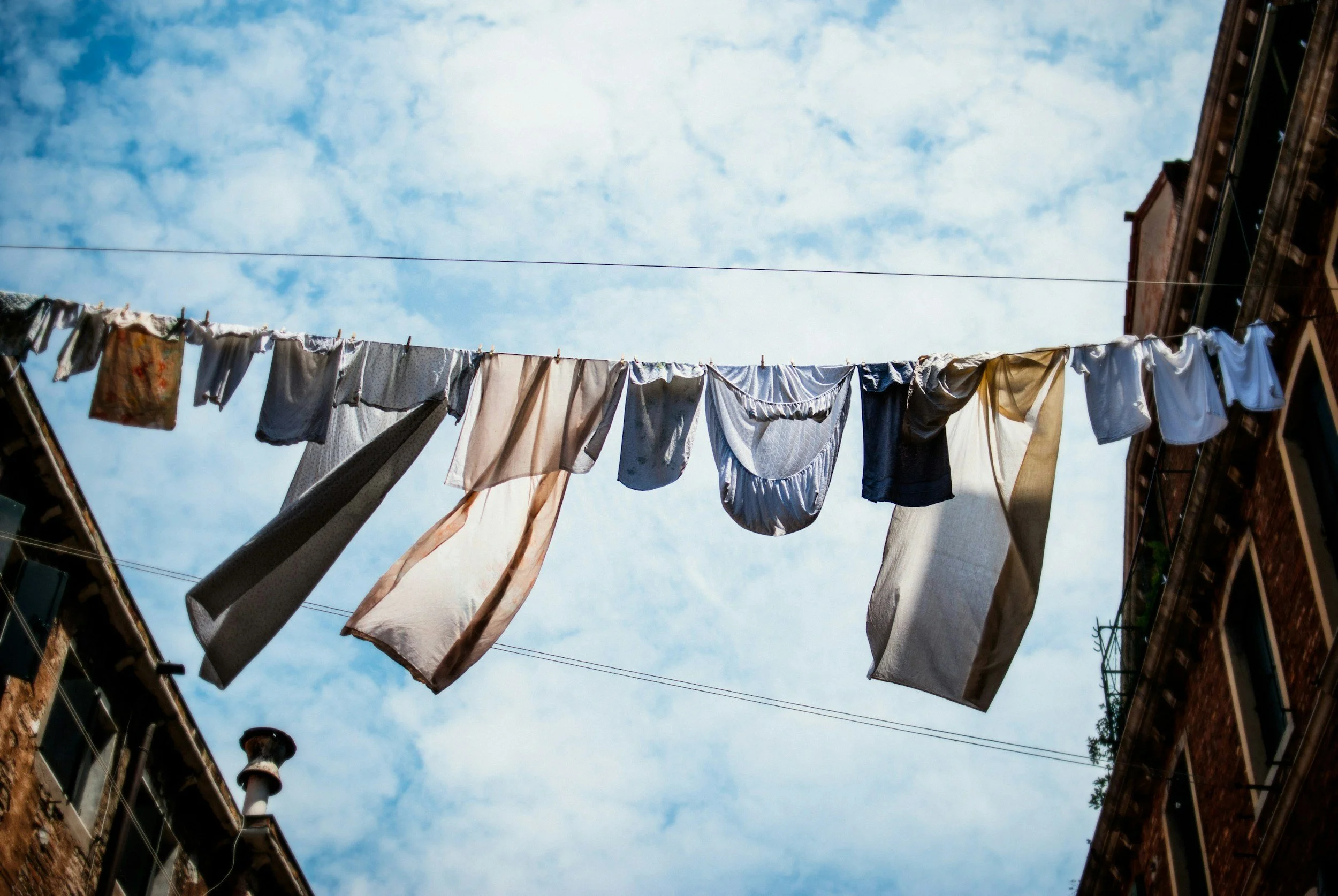
When I was a kid, during the warmer months, my mom would hang our laundry out to dry on the clothesline in our backyard. Socks hung next to T-shirts next to bedsheets. On the best days the clothes would dance, animated by the breeze and highlighted against a deep blue summer sky.
The clothes would come back indoors smelling fresh —a combination of sunshine, breezes, and newly mown grass. I remember the heavenly scent and the crispness of my pillowcase, which had hung on the line during the day, as I lay in bed at night.
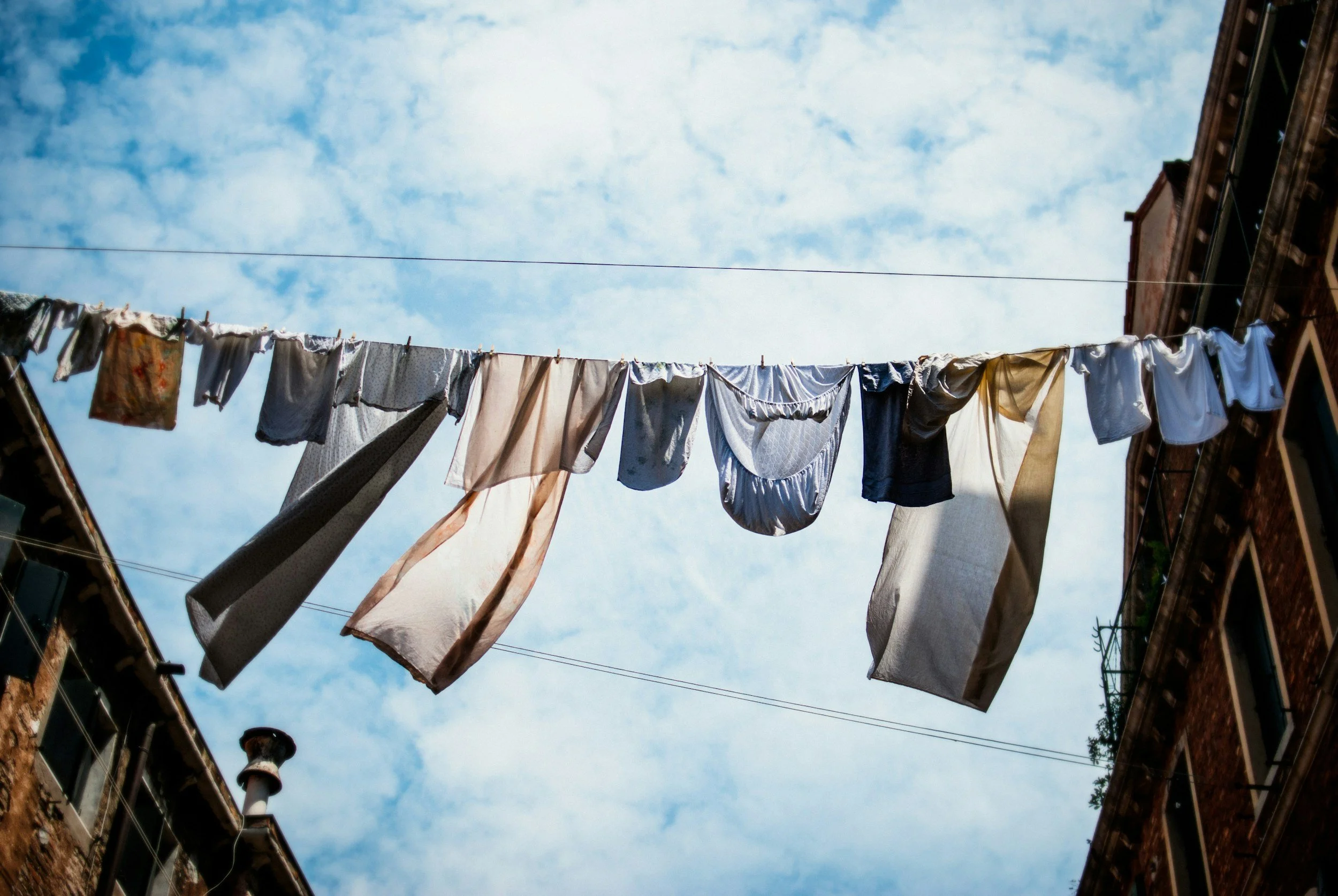
photo by Erik Witsoe via Unsplash
Any time I have had the privilege of walking the narrow streets of a European town, I have been attracted to the clothes hanging out to dry. The lines are often high above the cobblestones on which I walk and stretched between ancient stone walls and wrought iron balconies. Maybe it is the soft and responsive-to-every-breeze quality of the laundry juxtaposed with the immovability of these walls that appeals to my eye. And maybe part of me recalls the simpler times of childhood when it seemed everything could be solved by a good washing and some time outside in the sunshine.
In her book, Holiness Here, Karen Stiller paints a beautiful picture of repentance using the clothes-on-a-line metaphor. She says,
“We are made clean—washed like the laundry that hangs on the line and sways and dries in the breeze—because of Jesus. So, we confess our brokenness, always, but we can also pause to appreciate how clean, fresh, and new we now get to be.”
The other night, I was awake for hours. What ifs were running rampant in my mind.
My brain was desperately trying to problem solve. I tried to pray and give the situation I was ruminating on into more capable hands, but my mind just kept returning. I finally got up in frustration. I needed to find my way back to rest. I read this particular passage in Karen’s book and the image comforted me. I could visualize it. It became for me something to hold onto—a reminder of mercy always available.
I took the image of clean laundry dancing in the breeze under a blue sky with me as I slipped under the covers again. I was able to sleep comforted by the picture conjured up by the words, and by the truth of an ever-present mercy.
Sometimes we need another person beside us to listen and hold the ache alongside us, to place a hand over ours for us to settle and come back to a place of calm. Other times we need to move our bodies to work out the tension we are holding. It’s like we are shedding our old skin as we move, replacing our spiraling ways with a new perspective. I’ve heard it said that “motion is lotion”, in moving our bodies our minds are soothed. And sometimes, like in my experience with the laundry image, we need beauty to dwell on.
I have found recently that writing out a lament is helpful for moving my mind through the stress and pain I am experiencing. When we can honestly name the loss — that alone has power. We can spend time there and articulate all that is not as we would like. A body scan can be helpful to see where the stress has lodged, what feels tight and constricted — it is often my breath.
“To lament our pain is to honor the beauty God intended and yearn toward its restoration.” Sarah Clarkson
The beauty of a lament is that we don’t do it alone. We are speaking to God about it all — the one who can actually do something about the place we find ourselves. For me, just expressing how much something hurts and allowing God to soothe those places gives me what I need to keep moving forward. Nothing has changed about my situation, but I have been seen, heard, and soothed in the presence of the One Who Sees.
We have it in us to offer this to one another as well. Once we have experienced this kind of attunement, we can offer it too. We know what it means to be heard in all of our messiness, confusion, and anger. We have found the freedom in naming what is true and what has been lost and we can invite others into that also. This is where we experience true community.
As I packed for a short road trip last week, I found myself anticipating goodness and beauty in the days ahead. We were not going anywhere exotic, but there is something about getting away that ushers me into anticipation mode.
I notice this and wonder why expectation is not my response every morning as I wake up? I forget that each day is a miracle. I become blind to all that is right in front of me in my daily regular life. Maybe it has something to do with that old saying, “familiarity breeds contempt”.
Last year I wrote about how intention can prime our attention – how anticipating goodness can open up our senses to notice it. I want to wake up each and every morning, not rehearsing my to-do list first, but by opening myself up to all the day will hold. To live fully awake and aware of how God is present with me right here. I don’t need to leave my familiar environment to chase beauty elsewhere – it can be found in the most ordinary of moments in my right now life.
The Welcoming Prayer by Father Thomas Keating might be a great way to start the day and an ongoing practice of release and openness.
Welcome, welcome, welcome.
I welcome everything that comes to me today, because I know it's for my healing.
I welcome all thoughts, feelings, emotions, persons, situations, and conditions.
I let go of my desire for power and control.
I let go of my desire for affection, esteem, approval, and pleasure.
I let go of my desire for survival and security.
I let go of my desire to change any situation, condition, person or myself.
I open to the love and presence of God and God's action within.
Amen.
So, let’s be honest with where we are at, lament all that is not as it should be, and learn to welcome all in full surrender.
Here’s to a summer of anticipation of goodness and beauty and the presence of a good and beautiful God who walks with us through our days.
Originally published on Substack.